
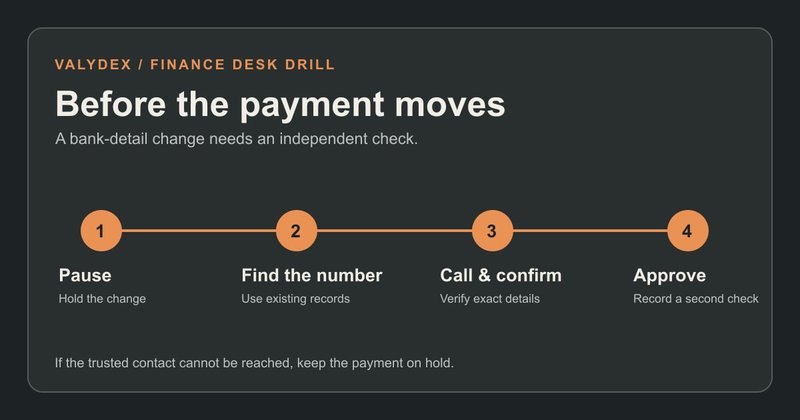
This ten-minute exercise gives a small finance team words and steps to use under pressure. It is a companion to Valydex’s full BEC payment-verification procedure, which covers triggers, records, exceptions, and response in more detail.
Run the drill
- Minute 1 — Pause. Put the bank-detail change or unusual transfer on hold. Keep the original request. Do not treat urgency, a familiar sender name, or a convincing voice as approval.
- Minutes 2–3 — Find the trusted number. Open the supplier record, signed contract, or approved internal directory. Do not use the number in the email, invoice, signature, text message, or incoming call.
- Minutes 4–6 — Make a new call. Ask the known contact to confirm the exact change and relevant payment details in a fresh conversation. If you cannot reach them, keep the payment on hold.
- Minutes 7–10 — Check and record. Have a second authorized person review the request, callback result, and payment details before release. Record whom you called, when, which trusted record supplied the number, what was confirmed, and who approved.
Use a simple script
“We received a request to change payment details. Our process requires me to call the number already in our records and confirm the exact change before we can act. I will also record the second approval.”
Practice the line with a colleague playing an urgent supplier or executive. The goal is not to detect whether a message or voice is AI-generated. The goal is to follow a verification path that still works when the message is convincing.
Decide the exception before it happens
Who can place a payment on hold? Who is the backup approver if the primary approver is away? Where is the trusted contact list kept, and who may change it? Agree on those answers before a Friday afternoon request arrives. An unavailable contact is a reason to wait, not to skip the callback.
If a suspected fraudulent payment has already moved, contact the originating bank immediately to request its recall or reversal process. Preserve the request and approval trail, then follow your incident process. The FBI IC3 BEC guidance also recommends secondary-channel verification and prompt bank contact.
For the complete procedure and a finance-team checklist, read Spot the Fake: BEC Payment Verification on Valydex.